
Best Shower Fan Timer Switches for Energy Savings and Easy Automation
Answering the search intent for a simple, reliable way to control bathroom fans and lights, these timer switches automate shutoff to save energy and reduce running time. They are ideal for homeowners seeking automatic ventilation, renters needing quick upgrades, and DIYers wanting straightforward installs. The top picks below focus on models with clear presets, easy wiring, and practical safety features. A quick buying table follows to help compare key options at a glance.
| Product | Brand | Best For |
|---|---|---|
| Leviton Countdown Timer Switch, 10-20-30-60 min | Leviton | Longer control blocks for bathrooms with larger exhaust needs |
| Leviton Countdown Timer Switch, 5-10-15-30 min | Leviton | Compact, budget-friendly timing for standard baths |
| ENERLITES Countdown Timer Switch, 5 min – 4 hours | ENERLITES | Flexible timers with neutral wire option |
| BN-LINK Countdown Digital Wall Timer, 5-60 min | BN-LINK | Six presets with optional repeat function |
| BN-LINK 60 Minute Spring Wound Timer | BN-LINK | Fully adjustable, mechanical timer without neutral |
Leviton Countdown Timer Switch DT160-1LW (10-20-30-60 min)

Features four preset times for automatic shutdown and a shallow design for easier wallbox installation. It supports a range of loads, including LED/CFL lighting, incandescent/halogen, and fans. The Green Flex Sleeve offers ground wiring options when no neutral is present, with a note that a ground wire is required.
Best for: Bathrooms with mixed lighting and fans that benefit from longer, defined off-times. Suitable for installations where a neutral may not be available. Limitations: requires careful ground wiring if a neutral is absent.
Leviton Countdown Timer Switch DT130-1LW (5-10-15-30 min)

This model mirrors the DT160 design with four smaller presets, making it ideal for compact baths or tighter wallboxes. It shares the same neutrally flexible ground/Sleeve approach and supports similar power loads for fans and lights. The shorter preset range can be easier to manage for quick bathroom routines.
Best for: Spaces needing a compact, easy-to-program timer with quick on/off control. Limitations: fewer time options than the 60-minute variants.
ENERLITES Countdown Timer Switch HET06-4H-W, 5 min – 4 hours

With a six-time option range and a dedicated blue LED indicator, this model helps users verify a setting in dimly lit bathrooms. It requires a neutral wire, which ensures stable control for LEDs and CFLs. The timer is designed to reduce energy waste by automatically cutting power after the set interval.
Best for: Bathrooms that have neutral wiring and LED lighting where reliable timer indication is helpful. Limitations: neutral wire required for full functionality.
BN-LINK Countdown Digital Wall Timer, 5-60 min
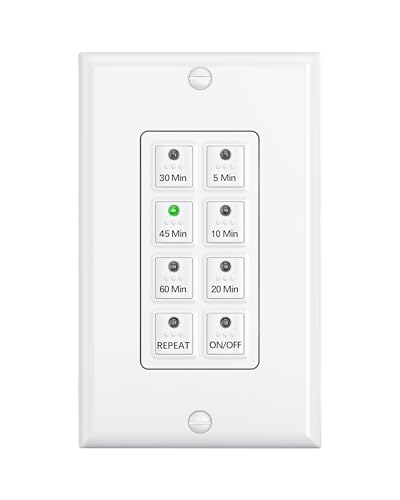
Six preset options plus a repeat function and manual override provide flexible scheduling for bathroom lights and fans. It emphasizes energy savings by automatically turning off after the countdown. The device is designed for straightforward wallbox installation and includes a wall plate.
Best for: Anyone who wants repeatable daily timing with a simple manual override. Limitations: some users may prefer warm-up or longer delay options beyond 60 minutes.
BN-LINK 60 Minute Spring Wound Timer

This mechanical timer offers full manual control with a knob to set any shut-off time from 2 to 60 minutes. It requires no neutral wire, making it a good fit for older wiring. It is particularly suited for bathrooms, closets, and other small spaces where a mechanical, no-fuss timer is preferred.
Best for: Homes with no neutral wiring or renters seeking a simple, mechanical option. Limitations: may lack electronic indicators and presets of digital models.
Buying Guide: Timers For Shower Fans And Lights
When choosing a shower fan timer switch, consider wiring, load compatibility, and installation complexity. If your wallbox lacks a neutral, select a model that supports neutral-free wiring or uses a ground sleeve correctly. For LED and CFL lighting, ensure the switch is rated for low-wattage loads to avoid nuisance tripping.
Key questions to guide your decision:
- Do you have neutral wiring in the wallbox, or is a no-neutral option required?
- What is the typical fan or light load you need to control (watts, amperage, or HP)?
- Do you prefer presets (5–60 minutes) or a fully adjustable, mechanical timer?
- Is a waterproof or moisture-rated device necessary for a bathroom environment?
- Will you benefit from a blue LED indicator showing timer status?
Installing a timer switch usually involves turning off power at the breaker, wiring the line, load, and ground as directed by the product’s instructions, and testing the device after power is restored. Always follow local electrical codes and consider professional installation if you are unsure about wiring or neutral requirements.
Frequently Asked Questions
- What is a countdown timer switch used for in a bathroom? It automatically turns off fans or lights after a set period, helping save energy and reduce moisture exposure.
- Do all timer switches require a neutral wire? No. Some models support no-neutral installations, while many digital options require a neutral for reliable LED/CFL performance.
- Can a timer switch replace a standard wall switch? Yes, most are designed to replace standard single-pole switches in typical bathroom circuits.
- Are mechanical timer switches as effective as digital ones? Mechanical timers offer simple, no-power-required operation, but lack digital presets and indicators found in electronic models.
- What indicators help with timer usage in dim bathrooms? LED indicators or small status LEDs help confirm when a timer setting is active or completed.
- Is it safe to install a timer switch myself? If you are comfortable with basic electrical work and comply with safety standards, it is feasible; otherwise, hire a licensed electrician.