
Best DC-DC Solid State Relays for Reliable Control in 2026
Answering the common buyer intent: choose a DC-DC solid state relay (SSR) when you need fast switching, long life, and clean electrical isolation between control (DC input) and load (DC output). This guide highlights five dependable options suited for hobbyists, small automation projects, and compact control panels. Each product is evaluated for who it’s best for, potential limitations, and why it stands out in its class.
| Product | Input / Output (DC) | Current Rating | Key Benefit |
|---|---|---|---|
| Coliao SSR-40DD | 3-32VDC / 5-200VDC | 40A | Compact, solid performance for medium loads |
| BlueStars SSR-25DD | DC 3-32V Input / DC 5-200V Output | 25A | Clear specs and robust construction for automation |
| CGELE SSR-25DA | 3-32VDC / 24-480VAC | 25A | Versatile for mixed AC output needs |
| CGELE SSR-60DD | 3-32VDC / 5-240VDC | 60A | High current capability for heavier loads |
| LCLCTC SSR 40 DD | DC to DC (3-32V Input / 3-75V Output) | 40A | Includes radiator for cooling; compact installation in tight spaces |
Coliao 3pcs SSR-40DD Solid State Relay
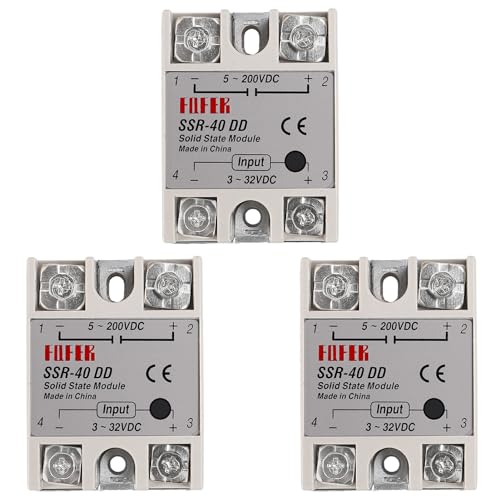
Best for mid-range control tasks in compact enclosures. The SSR-40DD handles up to 40A with a DC input range of 3-32V and DC output up to 200V. Its small footprint (62×45×24 mm) makes it suitable for panel installations where space is at a premium. Best for hobby projects and small CNC or heating/cooling control where consistent switching is required. Caution: ensure adequate heatsinking in continuous operation, as higher current can heat the device.
BlueStars SSR-25DD DC Solid State Relay

Better for precision automation and temperature control projects requiring predictable switching and detailed specifications. The SSR-25DD offers DC input 3-32V and DC output 5-200V with 25A switching capability. Its documented dimensions (58×45×32 mm) and robust build support steady performance in automatic processes, heating/cooling cycles, and CNC applications. Best for: compact automation panels where quiet, clean switching matters. Caution: verify heat dissipation in high-duty cycles to avoid thermal throttling.
CG Solid State Relay SSR-25DA

Choose this if your project needs DC input with a flexible AC output range. The SSR-25DA provides 3-32VDC input and a 24-480VAC output at 25A, making it suitable for mixed-load environments where you might control AC-powered devices from a DC control signal. Best for: automation circuits that interface with AC loads and need reliable, spark-free switching. Limitation: for strictly DC-only loads, a DC-DC option can be more straightforward.
CG Solid State Relay SSR-60DD

Best for higher-load applications requiring robust switching. The SSR-60DD has a DC input range of 3-32V and a DC output range up to 240V with a 60A rating. It is well-suited for industrial projects, heating systems, or other demanding DC-DC control scenarios. Caution: ensure proper cooling with the included thermal grease and consider using additional heatsinking for continuous operation at upper current levels.
LCLCTC SSR 40 DD
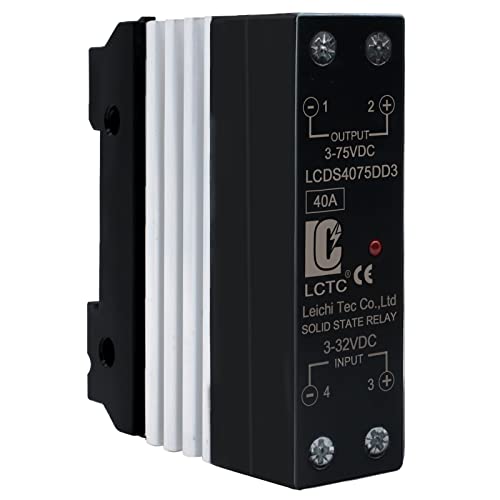
Best for narrow spaces and distribution-box installations. The LCLCTC SSR 40 DD is a DC-to-DC relay with 3-32V input and 3-75V output, plus a built-in radiator. This makes it particularly suitable for compact control panels where space is limited and heat dissipation is a concern. Limitation: ensure the output voltage remains within its 3-75V range for safe operation.
Buying Guide: Key Considerations For DC-DC SSRs
- Current rating vs. load demand: Match the SSR current rating to your maximum load. Oversizing helps reliability but costs more and increases size.
- Input control voltage: Most DC-DC SSRs use 3-32V input. Confirm your control signal is compatible with the SSR’s input range to avoid improper triggering.
- Output voltage range: Ensure the SSR’s output can handle your load’s operating voltage (DC or AC where applicable). For DC-DC tasks, you want a DC output within your circuit’s requirements.
- Thermal management: High current implies more heat. Some models include thermal grease or radiators; consider additional heatsinking for continuous use.
- Physical footprint: If space is scarce, prefer compact modules and consider mounting options (panel vs. distribution box).
- Reliability factors: Look for devices with robust construction and clear specifications for frequency and duty cycle, especially in automation environments.
Frequently Asked Questions
- What is a DC-DC solid state relay used for?
It switches DC loads using a DC input to provide fast, spark-free control in automation and heating/cooling systems. - Do SSRs have a longer life than mechanical relays?
Generally yes, because there are no moving parts, reducing wear from mechanical switching. - Can I use an AC SSR for DC loads?
Not reliably. DC-DC SSRs are designed specifically for DC pathways; use AC-DC or DC-DC types accordingly. - Is heatsinking necessary for all SSRs?
Not all, but high-current models often require cooling to maintain performance and longevity. - How do I choose between 25A and 60A SSRs?
Choose based on peak load current and safety margin. Heavier loads benefit from higher current ratings with adequate cooling. - Do DC-DC SSRs come with installation accessories?
Some models include thermal grease and mounting aids; verify packaging details before purchase.