
Best 150Ah Lithium Battery for Off-Grid Power and RV Systems
Finding a reliable 150Ah lithium battery is essential for RVs, solar setups, marine use, and off-grid homes. The following five models deliver high energy capacity, robust BMS protection, and long lifecycles, making them suitable for deep-cycle applications. This guide highlights key features, performance considerations, and practical installation tips to help you compare options and choose the best fit for your power needs.
| Product | Brand | Capacity | Key Feature |
|---|---|---|---|
| DUMFUME 12V 150Ah LiFePO4 | DUMFUME Store | 150Ah / 1920Wh | Built-in 100A BMS, deep cycle, lightweight |
| OGRPHY 48V 150Ah Lithium Cart Battery | OGRPHY Store | 150Ah / 7.68kWh | 200A BMS, LCD monitor, 70 miles range (cart) |
| DUMFUME 12V 150Ah LiFePO4 Deep Cycle | DUMFUME Store | 150Ah / 1920Wh | 100A BMS, low weight, compact |
| Redodo Smart Bluetooth 12V 140Ah | Redodo Store | 140Ah / (approx. 1.4–1.6kWh per cell pack) | Bluetooth app monitoring, 10-year lifespan |
| 12V 150Ah LiFePO4 With 100A BMS | Unspecified Brand | 150Ah / 1920Wh | Low temp cut-off, compact design |
DUMFUME 12V 150Ah LiFePO4 Deep Cycle Battery

The 12V 150Ah LiFePO4 battery from DUMFUME is engineered for long-term energy storage, offering 1920Wh of usable power and more than 4,000 deep cycles while retaining up to 80% capacity. A built-in 100A Battery Management System (BMS) provides full protection against overcharge, over-discharge, short circuits, and overheating, safeguarding solar panels, RV systems, and off-grid setups. At a compact 22.05 lbs and dimensions around 13.05×6.78×8.66 inches, it is notably lighter and smaller than many lead-acid alternatives, making installation in tight spaces straightforward. The design supports various off-grid applications, including solar storage, marine use, and backup power for homes or small cabins. For extended storage, a maintenance cycle every six months is recommended.
For RVs and camper vans, the lightweight form factor helps with weight distribution and mounting flexibility. While it excels in stationary storage and backup power, users should note that this model is intended for storage and energy storage rather than engine starting in some configurations. Ensure compatibility with your existing solar charge controllers and inverters, and plan for a proper BMS integration with your charging equipment.
OGRPHY 48V 150Ah Lithium Golf Cart Battery
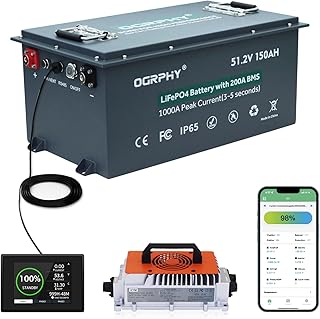
This 48V 150Ah LiFePO4 battery targets golf cart performance with a 7.68kWh energy capacity and a high-performance battery management system. The 200A BMS supports peak currents up to 1000A for short bursts, providing reliability during steep climbs and rugged terrain. An LCD touch monitor, plus a companion mobile app, enables real-time monitoring of voltage, current, state of charge, and other vital statistics, giving operators immediate insight into battery health on the course or during maintenance checks. The combination of high discharge capability and app-based monitoring makes it attractive for users who value advanced diagnostics and remote oversight. It’s suitable for golf carts, off-grid carts, and other 48V systems requiring robust protection and performance.
Considerations include ensuring proper venting, integration with existing 48V inverters and chargers, and understanding the BMS’s protection parameters for long-term durability. The larger form factor and higher voltage require compatible components and careful installation in confined spaces. While the built-in monitoring adds convenience, ongoing software updates and app permissions should be managed to maintain compatibility over time.
DUMFUME 12V 150Ah LiFePO4 Deep Cycle Battery With 100A BMS

This model emphasizes long life and safety with a built-in 100A BMS, delivering an energy capacity of 1920Wh and a 4,000+ cycle lifespan (80% capacity retention). The compact package weighs about 22.05 lbs and measures 13.05×6.78×8.66 inches, so it’s well-suited for RVs, boats, solar storage, and off-grid sheds where space is at a premium. It is designed for 12V systems and is appropriate for use as a power reserve for lighting, fans, multimedia, and low-draw appliances during outages or remote camping trips. Ensure appropriate inverter compatibility and BMS integration for safe charging and discharging, especially in variable outdoor temperatures.
When integrating into a system, consider battery placement, ambient temperature effects on performance, and the need for proper fusing and disconnects. The battery’s low-temperature protection helps extend life in cool climates, but charging limits may require a heater-enabled setup in frigid environments.
Redodo Smart Bluetooth 12V 140Ah LiFePO4 Battery

The Redodo 12V 140Ah LiFePO4 battery expands capacity within the same footprint, delivering enhanced energy density. A notable feature is Bluetooth app monitoring, enabling real-time access to voltage, current, power, and remaining capacity. Redodo markets a 10-year lifespan, contrasting with the shorter lifespan of many lead-acid options. This model is oriented toward RVs, marine use, solar storage, and off-grid applications where remote diagnostics offer value for maintenance and reliability. The Group 31 configuration is common in RV and marine installations, simplifying compatibility with standard racks and mounting arrangements.
Potential considerations include ensuring your Bluetooth device has reliable pairing in outdoor environments and understanding the app’s data presentation for quick interpretation during travel or remote camping. The 140Ah rating paired with modern BMS provides solid protection but verify the system’s tolerance for sustained high-current draws in hilly terrains or windy conditions where energy consumption may exceed expectations.
12V 150Ah LiFePO4 With 100A BMS and Low Temp Protection

This 12V 150Ah LiFePO4 option emphasizes low-temperature protection, with a 100A BMS that guards against overcharge, over-discharge, shorts, and overheating. The compact 12.8×6.5×8.46-inch design weighs roughly 28.64 lbs and delivers about 1290Wh of usable energy, which is lower than the 1920Wh figures of some peers but can be ideal for smaller RVs or marine cabins where space or weight is a critical constraint. The battery supports up to 15,000 cycles at 60% DOD, which is favorable for long-term use in stationary setups and periodic travel. The kit is suited for solar storage, RVs, and marine applications, including backup power for essential devices, lighting, and fans.
Installation considerations include careful thermal management, ensuring compatibility with inverters and charge controllers that can exploit the BMS’s protections, and planning for low-temperature operation to avoid charging restrictions. This model is well-suited for users prioritizing longevity and a compact footprint over maximum energy capacity in tight systems.
Buying Guide
Key purchase considerations for 150Ah LiFePO4 batteries include energy density, lifecycle, safety features, and system compatibility. LiFePO4 chemistry offers longer cycle life, typically 2,000–4,000+ cycles at meaningful DoD, compared with lead-acid, which yields lower total cost of ownership over time due to reduced replacement frequency and maintenance.
- Battery Management System (BMS): Look for a BMS that supports overcharge, over-discharge, short-circuit, and temperature protection. A higher current rating (e.g., 100A–200A) is beneficial for devices with high startup or surge requirements.
- Voltage and compatibility: Ensure the battery voltage matches your system (12V vs 48V) and that your inverter/charger are designed for LiFePO4 chemistry. Group 31 configurations are common in RVs and marine setups; verify mounting and wiring compatibility.
- Energy capacity and real-world usable energy: While labeled as 150Ah, consider the actual usable energy at a given DoD (depth of discharge). 80% DoD is a common design target to maximize lifespan while delivering practical runtime.
- Weight and size: Lighter, compact designs simplify installation in limited spaces, but verify mounting clearances, venting (if applicable), and balance with the vehicle or boat’s weight budget.
- Operating temperature: Low-temperature protection helps preserve battery life in cold climates, but charging efficiency and safety may require pre-warming strategies or heaters in very cold environments.
- Monitoring and diagnostics: Bluetooth or app-based monitoring adds convenience for remote status checks, especially in off-grid or traveling setups. Ensure data access is reliable and compatible with your devices.
- Maintenance and storage: Some batteries require periodic maintenance cycles during long-term storage. Follow manufacturer guidelines to prevent capacity loss and ensure readiness after storage periods.
- Warranty and support: Verify warranty terms, replacement policies, and access to customer support. A robust warranty reflects confidence in the product’s longevity and usability across seasons and environments.
When evaluating options, consider your primary use case—whether you need utility for RV life, marine adventures, solar storage, or home backup. Durability, protection features, and scalability (ability to add more batteries to an existing system) are important for long-term reliability. Finally, assess total cost of ownership, including charging equipment, wiring, and installation labor, to determine the best value for your off-grid power needs.