
Best Battery-Powered Generators for Keeping a Refrigerator Running During Outages
When outages strike, a reliable battery-powered generator can be a practical lifeline for a refrigerator, preserving perishable food and keeping essential meds safe. This article reviews top-capacity portable power stations with LiFePO4 batteries, fast charging, and multiple outlets suitable for home backup, camping, and off-grid living. Each pick balances high energy density, safety, and versatility to power refrigerators and other critical devices during emergencies or recreational trips.
Summary table of chosen products:
- Anker SOLIX C1000 Gen 2 Portable Power Station — 1,024Wh LiFePO4, 2,000W continuous, fast recharge
- EF ECOFLOW Delta 2 — 1,024Wh LiFePO4, 1,800W output, scalable capacity
- ABOK Portable Power Station — 3,840Wh LiFePO4, 3,600W output, high capacity
- Anker SOLIX F2000 Portable Power Station — 2,400W output, long-lasting LiFePO4
- Jackery Explorer 1000 v2 — 1,070Wh LiFePO4, 1,500W output, fast charging
Anker SOLIX C1000 Gen 2 — Fast Recharge And High Surge

The Anker SOLIX C1000 Gen 2 delivers 1,024Wh of LiFePO4 capacity with a robust 2,000W continuous output (3,000W peak). Its HyperFlash fast recharge can fully recharge around 1,600W, enabling rapid power restoration after an outage or day trips. This model is designed for home backup, camping, and portable use, with a form factor that is 14% smaller and 11% lighter than similar 1kWh-class devices. Its 11-port configuration supports powering multiple devices simultaneously, making it suitable for refrigerators alongside lights, phones, and small appliances.
Key features include UltraFast recharge, multi-port outputs, and a durable LiFePO4 battery designed for long cycle life. For households prone to outages, this unit can be a reliable centerpiece for a minimal power setup that protects perishable foods without noisy gas generators.
EF ECOFLOW Delta 2 — Clean, Scalable Power

The EF ECOFLOW Delta 2 provides 1,024Wh LiFePO4 capacity with an 1,800W continuous output and 100W USB-C, making it a versatile choice for fridges and daily devices. The 7x faster charging claim aims to reduce downtime, reaching 80% in about 50 minutes and 100% in roughly 80 minutes with AC input. The system is expandable up to 3 kWh by integrating additional batteries, which is advantageous for longer outages or larger off-grid needs. Its high output and broad port selection help keep a refrigerator running while other essentials stay powered during extended events.
Outlets include multiple AC ports, USB-C, and USB-A, enabling uninterrupted fridge operation alongside laptops, routers, and more. The Delta 2 is well-suited for users who want a scalable solution with rapid replenishment after use.
ABOK 3840Wh LiFePO4 Power Station — High Capacity

The ABOK portable power station emphasizes high capacity and long-term reliability with a 3,840Wh LiFePO4 battery and expandability up to 11,520Wh. It outputs up to 3,600W (4500W peak) and supports diverse charging methods, including AC, solar (PV), and car charging, enabling rapid recharging and flexibility in off-grid settings. With 15 output ports, it can handle multiple devices—essential when a refrigerator is part of a larger outage plan. The LiFePO4 chemistry contributes to a long lifecycle with thousands of cycles, which can be advantageous for repeated outage scenarios or ongoing off-grid usage.
This model prioritizes capacity and flexibility, making it attractive for users who want a robust power source for longer outages or more demanding load profiles involving fridges and other appliances.
Anker SOLIX F2000 — High Power And Reliability
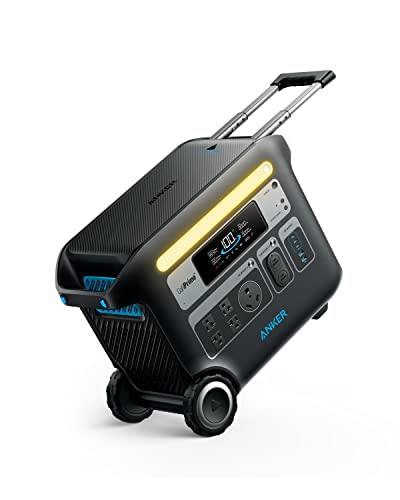
The Anker SOLIX F2000 offers a strong 2,400W continuous output, with considerations for high-demand devices and simultaneous loads. The device uses LiFePO4 chemistry for extended battery life and durability. Its design supports powering multiple devices with a broad port array, including AC outputs and USB-C/USB-A options, making it a flexible option for refrigerators during outages, RV living, camping, and home backup. While higher in output, it remains portable enough for routine use in and around the home or on trips where a sturdy energy source is needed. Surge protection and efficient charging help keep your refrigerator and other essentials operational during emergencies.
Jackery Explorer 1000 v2 — Reliable LiFePO4 Power

The Jackery Explorer 1000 v2 is a portable power station with a 1,070Wh LiFePO4 battery and a 1,500W continuous output (3,000W surge). It also supports fast charging and an emergency charging option via the Jackery app, achieving a rapid top-off in favorable conditions. Its 10-year design target and durable build provide a long lifecycle, which is valuable for households relying on a refrigerator during outages or for outdoor use. The device is relatively light for its capacity, supporting easy transportation and placement in kitchens, living rooms, or garages where it may be needed during emergencies.
Buying Guide: Key Considerations For Choosing A Refrigerator-Supporting Battery Generator
- Battery chemistry and life: LiFePO4 chemistry offers longer cycle life and improved safety compared to other lithium types. Look for units rated for thousands of charge cycles and a stable nominal voltage to protect a refrigerator’s compressor and electronics.
- Capacity and inverter power: For a refrigerator, ensure the unit delivers enough wattage to handle startup surges and running loads. A 1,000–2,400W continuous output with higher surge ratings is typically adequate for most residential fridges, especially when paired with a higher capacity battery (≥1,000Wh).
- Recharging speed: Fast recharge reduces downtime after an outage. HyperFlash and similar fast-charging features can dramatically shorten time to full capacity, which is helpful after a power interruption or a day of use.
- Portability vs. capacity: Higher-capacity units tend to be heavier. Balance the need to move the unit around the home or campsite with the practical capacity required to sustain refrigeration for a typical outage duration.
- Expansion options: Some models support adding extra battery packs to reach 2–3 kWh or more. This can be valuable for longer outages or households with larger cooling requirements.
- Outlets and compatibility: Confirm it has at least one or two pure sine wave AC outlets and USB-C/USB-A ports for additional devices like routers, phones, and medical devices. A broader port set helps manage multiple devices during an outage.
- Safety and certifications: Verify built-in protections (short-circuit, overcharge, temperature monitoring) and electronics-grade isolation. UL or equivalence certifications can provide additional assurance for home use.
- Operational environment: Temperature range and operating conditions influence performance. Some models specify an optimal temperature window for charging efficiency and performance, which matters for in-home use and outdoor excursions.
- Warranty and support: A longer warranty and accessible customer support help ensure reliability during repeated outages or long-term use in RVs and cabins.
In practice, selecting a battery-powered generator for a refrigerator involves balancing capacity, charging speed, and portability. For smaller outages or limited space, a 1,000–1,070Wh LiFePO4 unit with 1,500W–2,000W output provides ample headroom for most refrigerators. For longer outages or households running multiple devices, higher-capacity options (3,000–11,000Wh ranges) with expansion potential offer more resilience, albeit with heavier and larger units. Consider the scenario: a single fridge plus essential devices during a 24–48 hour outage versus multiple appliances for several days. The buying decision should align with your typical outage duration and mobility needs, while prioritizing LiFePO4 stability and reliable recharging capabilities.